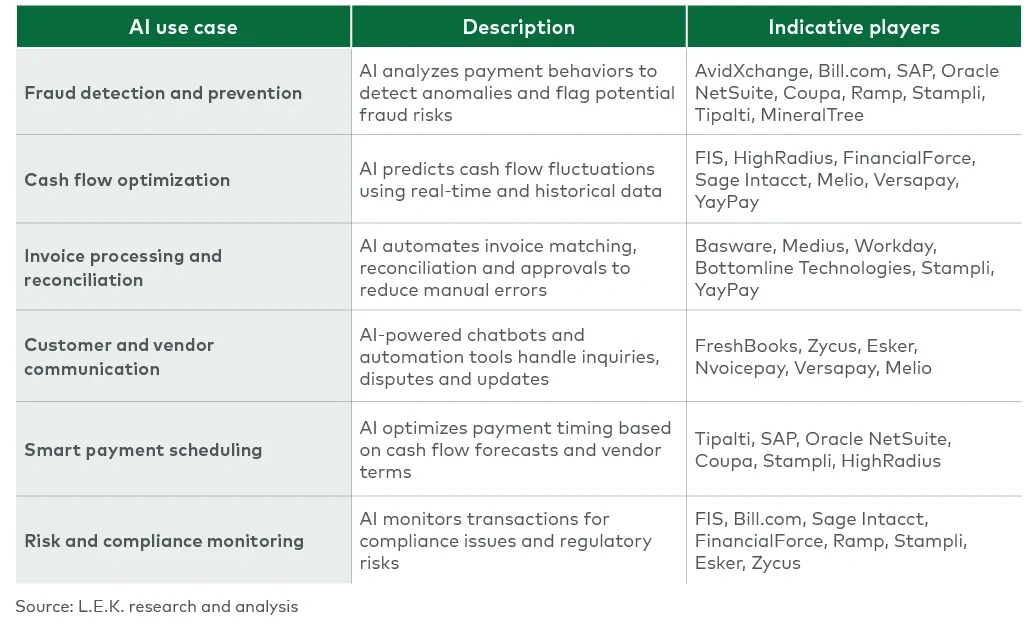

While automation in AR and accounts payable AP has existed for years, artificial intelligence (AI) is now fundamentally transforming these financial processes and driving their convergence with payment technologies. Today, market differentiation comes not just from adopting automation but also from leveraging AI-driven insights within AR and AP, integrating embedded payment functionality and exploring emerging technologies such as stablecoins.
Drawing on L.E.K. Consulting’s experience evaluating acquisitions and guiding strategic decisions for financial software leaders, this Executive Insights explores how the next generation of AR and AP solutions is creating new value across the ecosystem. As M&A activity accelerates, companies that understand both the AI transformation and payment convergence trends will be best positioned for growth and market leadership.
Demand drivers: Why AR and AP are more important than ever
Two key forces are fueling the growth of AR and AP automation: mounting financial pressures that make cash flow efficiency essential and the increasing accessibility of automation tools for businesses of all sizes. Together, these trends create a prime opportunity for software providers and investors to capitalize on value creation in this space.
1. The cash flow imperative
For businesses today, cash flow efficiency remains a top priority — a trend that took hold during the COVID-19 pandemic when liquidity became critical for survival. Five years later, AR and AP processes — the backbone of how money moves through a company — remain essential to financial stability. These functions provide real-time visibility into cash inflows and outflows, improving forecasting, liquidity planning and working capital optimization, such as capturing early payment discounts. At the same time, external forces such as tariffs, supply chain disruptions and economic volatility further underscore the need for agile cash flow management.
High interest rates have increased borrowing costs, intensifying the need for efficient cash management since the pandemic. Financial pressures continue mounting — 77% of small businesses cite rising costs as a major challenge and 52% struggle with operating expenses, while businesses of all sizes face 3.6% higher labor costs and projected 5.8% increases in health insurance premiums for 2025. Despite these pressures, many companies still rely on outdated AR and AP systems, creating significant inefficiencies, such as:
- Only 9% of AP departments have fully automated their processes, meaning most businesses still depend on outdated systems for at least some of their workflow
- Nearly half of invoices are still processed manually, leading to inefficiencies and higher costs
- Over 70% of AR invoices are still sent by mail, costing firms $16-$22 per invoice — an avoidable expense in an increasingly digital world
- Even large enterprises face inefficiencies — 60% use five or more AP systems, reducing visibility and complicating financial management
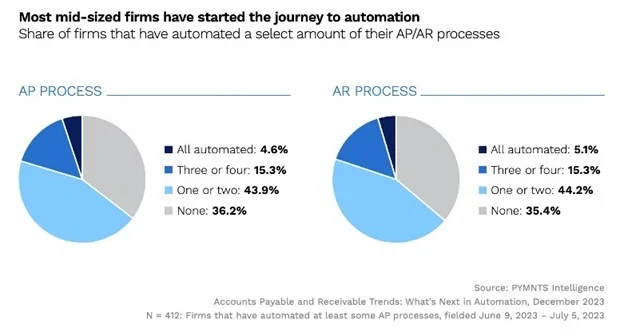
Despite growing interest in automation, full adoption remains rare, with just 4.6% of AP processes and 5.1% of AR processes fully automated. This gap highlights the urgent need for more efficient AR and AP processes to address liquidity strain, rising costs and limited financial agility, creating a significant opportunity for AI-driven solutions to streamline operations and optimize cash flow (see Figure 1).