

When a leading private equity (PE) firm sought to expand its North American footprint in the food and beverage industry, it engaged L.E.K. Consulting's Operations & Supply Chain practice to evaluate the operational health and scalability of a frozen foods contract manufacturer.
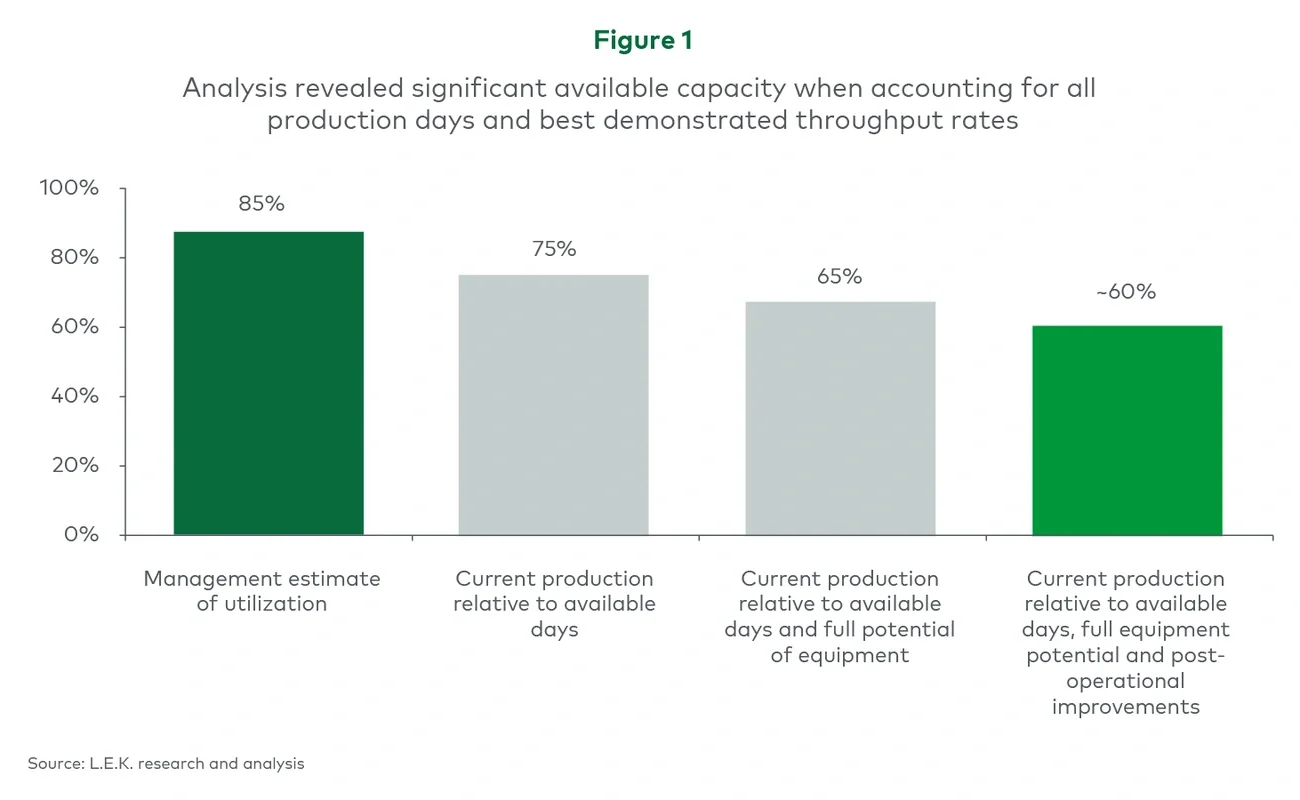
Through a focused operational due diligence (ODD), we uncovered untapped capacity by reassessing key operational metrics and challenging assumptions anchored to historical performance. The process revealed significant opportunities: True utilization was lower than initially reported (around 65% rather than 85%), enabling the postponement by two to three years of a planned $15 million capital expenditures (CapEx) investment and unlocking incremental capacity to support growth without costly expansions.
The challenge: Understanding true operational potential
The acquisition target, a frozen foods contract manufacturer, aligned with the PE firm's strategy of leveraging growing consumer demand for frozen convenience foods. However, thorough evaluation of both the target's current operational health and its scalability was required.
The ODD needed to address two fundamental questions:
1. How strong were current operations? While our initial review showed stable operations with good data collection and low employee turnover, several critical areas required deeper evaluation:
- Operational metrics: Accuracy of OEE, capacity and utilization
- Quality and safety: Historical performance trends and protocols
- Management systems: Maturity of operational processes
- Workforce stability: Employee turnover and capability
2. Could operations support future growth? The target's capacity and expansion plans required thorough validation:
- Growth trajectory: Five-year revenue and volume projections
- Current capacity: True utilization rates and equipment capabilities
- Operational requirements: Changes needed for volume growth
- Investment needs: Required CapEx and OpEx for expansion
Our approach
L.E.K.'s Operations & Supply Chain team employed a comprehensive assessment methodology combining data analysis with direct operational observations (see Figure 1).
The team established performance baselines through analysis of historical production data and key performance indicators while also developing a volume model to project five-year growth. Through facility visits and stakeholder interviews, we assessed production performance, facility management, employee relations and quality systems.
This systematic approach uncovered several critical insights:
- The target's reported utilization rate was significantly overstated
- Production targets were based on historical performance rather than equipment capabilities
- Revised capacity calculations enabled more accurate expansion timing